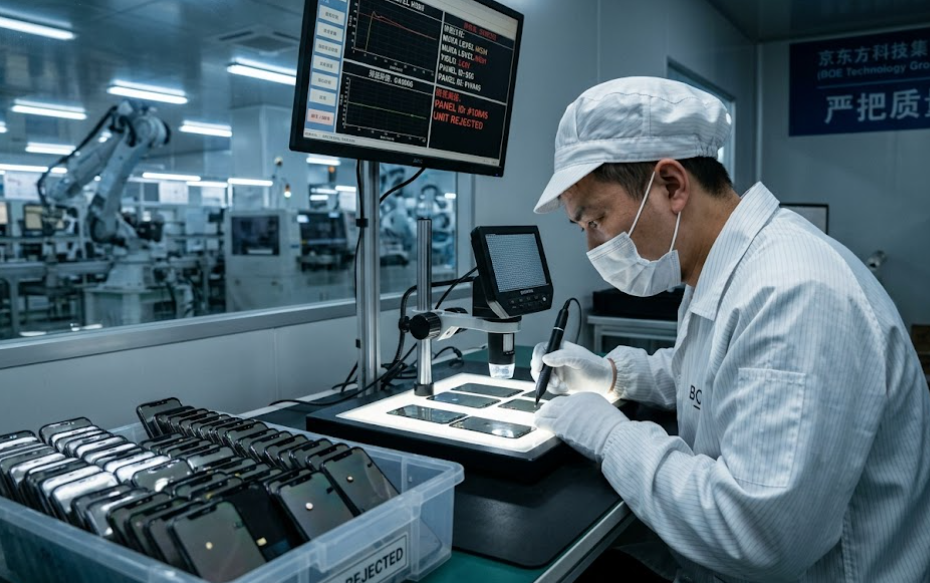
Apple display supply chain depends heavily on precision OLED manufacturing. BOE, a major Chinese display maker, has struggled to consistently meet Apple’s strict quality, yield, and durability requirements for iPhone screens at mass production scale. This issue directly affects shipment volumes, production stability, and long-term supplier relationships in premium smartphone displays.
BOE just can’t make good enough iPhone screens in volume
The core problem is not BOE’s ability to produce OLED panels. The real issue is consistent mass production at Apple-grade quality standards. Apple requires extremely low defect rates, precise color calibration, long-term burn-in resistance, and stable performance across millions of panels. BOE can produce competitive displays in small batches, but scaling to Apple-level volume introduces yield instability, quality variation, and certification delays. The practical solution for Apple has been diversification across Samsung Display and LG Display, while BOE continues gradual improvement through limited production approvals and restricted iPhone models.
Manufacturing Complexity Behind Apple iPhone Display Standards
Apple iPhone displays require advanced OLED architecture with extremely tight tolerances. Even minor inconsistencies in pixel alignment or thin-film transistor layers can cause rejection during Apple’s inspection process.
Precision requirements in OLED panel production
OLED manufacturing depends on nanoscale deposition of organic materials. Any variation in thickness or alignment impacts brightness uniformity and color accuracy. Apple applies stricter tolerances than most smartphone manufacturers, increasing rejection rates during BOE production cycles.
Yield rate limitations in mass production
Yield rate measures how many usable panels come from a production batch. BOE often achieves acceptable yields in controlled runs, but large-scale production for iPhone models introduces variability. This reduces efficiency and increases cost per usable display.
Quality control pressure from Apple certification
Apple applies multi-stage validation testing. Panels must pass durability stress tests, thermal cycling, and long-term luminance stability checks. BOE frequently faces rejections during these certification phases, limiting volume approval for flagship iPhone models.
Why BOE Struggles to Match Samsung and LG Display
Samsung Display and LG Display have years of experience supplying OLED panels for Apple devices. Their production systems are optimized for Apple’s strict requirements, creating a high entry barrier for BOE.
Technology maturity gap in OLED production
Samsung Display leads in flexible OLED and LTPO technology integration. LG Display also maintains strong expertise in large-scale OLED consistency. BOE is still closing the gap in advanced backplane technology and panel uniformity control.
Supply chain optimization advantage
Samsung and LG have vertically integrated supply chains with established material sourcing and fabrication efficiency. BOE’s supply chain is improving but still faces bottlenecks in critical OLED materials and equipment calibration.
Experience in Apple-specific calibration standards
Apple requires unique color profiles and refresh rate tuning for iPhone screens. Samsung and LG have long-term calibration alignment with Apple engineering teams, while BOE continues to adapt to these evolving requirements.
Impact of BOE Limitations on iPhone Production Strategy
Apple’s dependence on multiple suppliers is a strategic decision to reduce risk. BOE’s limited capacity directly influences production distribution across iPhone models.
Allocation of BOE panels to lower-tier models
BOE is often assigned displays for non-Pro or base iPhone models. This reduces pressure on extreme performance standards while still allowing BOE participation in Apple’s supply chain.
Supply chain risk management for Apple
Apple avoids single-source dependency. When BOE production fluctuates, Samsung Display and LG Display compensate to maintain global iPhone supply continuity.
Pricing and production cost implications
Higher rejection rates from BOE production increase cost inefficiency. This indirectly reinforces Apple’s reliance on established suppliers with higher yield consistency.
Technological Barriers Affecting BOE Scaling Capability
BOE’s main challenge is scaling advanced OLED technology without compromising consistency. This requires both hardware investment and process refinement.
LTPO OLED adoption challenges
LTPO (Low-Temperature Polycrystalline Oxide) technology enables variable refresh rates and improved power efficiency. BOE has struggled to match Samsung’s LTPO implementation quality at scale.
Equipment calibration and factory precision
OLED production requires highly calibrated deposition and etching equipment. Even microscopic misalignment in equipment reduces output quality. BOE continues upgrading fabrication lines to reduce variation.
Material consistency issues
Organic emissive materials used in OLED panels are sensitive to environmental conditions. Slight variations in chemical composition can impact brightness and lifespan, making mass production stability difficult.
Apple’s Supplier Strategy and Controlled Diversification
Apple does not rely on a single supplier for critical components like displays. Instead, it uses controlled competition between suppliers to improve quality and reduce cost.
Multi-supplier allocation model
Apple distributes iPhone display orders across Samsung Display, LG Display, and BOE. Allocation depends on model tier, production readiness, and quality certification results.
Gradual qualification approach for BOE
BOE is typically introduced in limited production batches. Apple expands BOE usage only after sustained quality performance over multiple production cycles.
Strategic pressure for innovation
Competition among suppliers encourages innovation. BOE’s continued participation pushes incremental improvements in OLED efficiency and cost structure.
Future Outlook for BOE in iPhone Display Production
BOE is not excluded from Apple’s ecosystem. Instead, its role is evolving gradually as technology and production stability improve.
Expansion potential in mid-tier iPhone models
BOE is more likely to expand production for standard iPhone models rather than Pro versions. This allows controlled scaling without risking flagship quality issues.
Investment in next-generation OLED technology
BOE is investing in advanced OLED architectures, including flexible panels and improved pixel density control. These developments may improve future Apple approval rates.
Long-term competition with established suppliers
Samsung Display and LG Display will continue leading Apple’s premium display supply. BOE’s growth depends on narrowing the gap in yield consistency and calibration precision.
Supply Chain Lessons from BOE’s iPhone Display Challenges
The BOE situation highlights the complexity of modern smartphone manufacturing ecosystems. High-end display production is not only about capability but also about repeatability at scale.
Importance of manufacturing consistency
Apple prioritizes predictable quality over isolated production success. A supplier must deliver stable output across millions of units without deviation.
Role of ecosystem experience
Long-term collaboration with Apple improves supplier performance. Experience reduces errors in calibration, testing, and integration processes.
Balance between cost and quality
Even if BOE offers cost advantages, Apple prioritizes performance stability for premium devices. This balance determines supplier allocation decisions.
Frequently Asked Questions
Why does BOE struggle with iPhone OLED production?
BOE struggles due to lower yield consistency and difficulty meeting Apple’s strict display calibration and durability standards at large scale.
Does Apple completely reject BOE displays?
Apple does not fully reject BOE. BOE supplies panels for limited iPhone models under controlled production volumes.
What makes Samsung Display more reliable for Apple?
Samsung Display has advanced OLED technology, higher yield stability, and long-term calibration experience with Apple requirements.
Can BOE become a major iPhone display supplier in future?
BOE can expand its role if it improves LTPO OLED production, yield rates, and long-term quality consistency.
Are BOE screens used in premium iPhone models?
BOE is generally limited to standard iPhone models, while premium Pro models rely on Samsung Display and LG Display.
Conclusion
BOE faces structural challenges in scaling OLED production to Apple standards. The issue is not capability but consistency under extreme manufacturing precision. Apple continues to rely on diversified suppliers to ensure stable global iPhone output. BOE remains a developing partner with gradual integration potential across future iPhone generations and mid-tier device segments.