Human exploration of Mars is gaining strong attention in modern space development. Many experts discuss why private space missions are accelerating toward 2026. The vision includes advanced rockets, human safety systems, and long duration survival planning. This topic reflects growing interest in interplanetary travel and future settlement possibilities worldwide research
Why Elon Musk is Preparing for Mars in 2026?
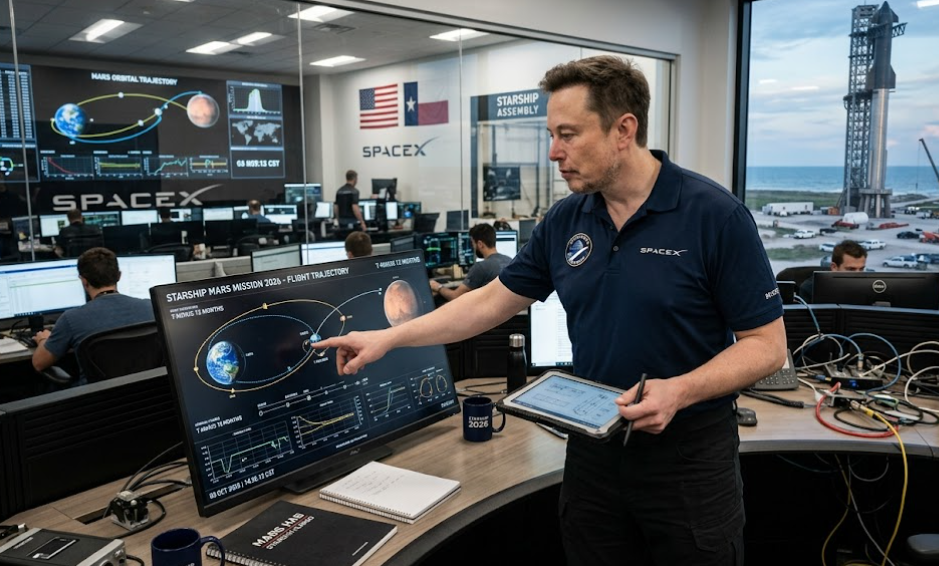
Elon Musk is preparing for Mars in 2026 to advance human space expansion through private sector innovation. The primary objective is to build a transport system capable of sending humans and cargo to Mars with reduced cost and higher frequency. The focus is on building self sustaining capabilities beyond Earth.
The central problem being solved is Earth dependency for long term survival of human civilization. Mars preparation involves transportation, habitation, energy systems, and life support infrastructure. The strategy is to make Mars missions repeatable instead of one time exploration events. This approach supports long term human settlement planning and scientific expansion.
Reasons for Mars Preparation
Mars preparation is driven by scientific, economic, and survival objectives. The goal is to create a backup environment for humanity in case Earth faces large scale risks. Space exploration also improves technological innovation on Earth.
A major reason is advancing space transportation efficiency. Lower cost travel enables frequent missions and material transfer. Another reason is expanding human presence beyond Earth orbit.
Private space companies play a central role in this transformation. SpaceX is developing reusable rocket systems that reduce mission cost and increase launch frequency. This supports long term Mars mission feasibility.
Technology development
Technology development focuses on propulsion systems, fuel efficiency, and spacecraft durability. Engineers are improving engines that can support deep space travel.
Advanced navigation systems are required for long distance interplanetary missions. These systems ensure trajectory accuracy and safe landing on Mars terrain.
Rocket reusability
Rocket reusability reduces the cost per mission significantly. Instead of discarding rockets after one use, systems are designed to return and relaunch.
This approach increases mission frequency and reduces resource consumption. It is a key factor in making Mars colonization financially realistic.
Role of SpaceX Starship
SpaceX Starship is designed as a fully reusable spacecraft for deep space missions. It is intended to carry humans, cargo, and scientific equipment to Mars.
The system focuses on high payload capacity and long distance endurance. It is designed to support both orbital missions and planetary transport.
Starship development is central to Mars mission timelines due to its scalability and cost efficiency.
Design and capacity
Starship is designed with large cargo capacity to transport equipment needed for Mars infrastructure. This includes habitats, energy systems, and food supplies.
The spacecraft uses stainless steel construction for durability under extreme temperature conditions. It is built to handle atmospheric entry on Mars and Earth.
Testing and milestones
Testing includes orbital flight trials, engine validation, and landing experiments. Each test improves reliability for long duration missions.
Milestones are set to gradually increase mission complexity. These milestones support readiness for human transport missions.
Human survival challenges
Mars presents severe survival challenges that must be solved before human settlement. These include radiation exposure, oxygen supply, and food production systems.
Temperature extremes and dust storms also create environmental risks. Engineering solutions are required for permanent habitation.
Radiation
Mars has weaker atmospheric protection compared to Earth. This increases exposure to cosmic radiation.
Shielding systems are required for human habitats. Underground or reinforced structures are considered safer options.
Life support
Life support systems must provide oxygen, water recycling, and temperature control. These systems must operate independently for long durations.
Closed loop systems are essential for reducing dependency on Earth supply chains. Food production systems must also be integrated.
2026 timeline expectations
The 2026 timeline reflects planned mission readiness goals rather than guaranteed human landing. It represents a target for testing and early mission validation.
The timeline includes spacecraft testing, cargo missions, and potential crew preparation stages.
Mission planning
Mission planning includes orbital mechanics, fuel logistics, and landing site selection. Engineers study Mars surface conditions for safe landing zones.
Resource planning focuses on long term sustainability of missions. This includes energy, communication, and life support systems.
Risks
Risks include technical failure, environmental uncertainty, and launch delays. Space missions require strict safety validation.
Delays are common due to testing requirements and system upgrades. Risk management remains a core part of planning.
Economic and scientific impact
Mars missions create economic opportunities in aerospace manufacturing, engineering, and materials science. New industries develop around space infrastructure.
Scientific benefits include planetary research, climate comparison studies, and geological analysis. Mars exploration also improves understanding of Earth evolution.
Colonization
Mars colonization involves establishing permanent human settlements. These settlements require independent resource systems.
Long term habitation may include agriculture, energy production, and scientific stations. The goal is self sufficiency.
Global collaboration
Global collaboration is necessary for large scale space missions. Multiple organizations contribute research, technology, and funding.
International cooperation increases mission success probability. It also expands scientific knowledge sharing.
FAQs
Why is Mars considered important for human future planning?
Mars is important because it provides a potential secondary habitat for human civilization in case of Earth risks.
What makes reusable rockets important for Mars missions?
Reusable rockets reduce mission cost and increase launch frequency which supports continuous space exploration.
How long does a Mars mission take from Earth?
A Mars mission typically takes six to nine months depending on planetary alignment and propulsion efficiency.
What is the biggest risk in Mars travel?
The biggest risk is radiation exposure combined with long duration isolation in deep space environments.
Conclusion
Mars preparation reflects a major shift in human space strategy. The focus is on building transport systems, survival infrastructure, and long term settlement models. These efforts combine engineering progress with scientific ambition. The 2026 timeline represents structured advancement toward sustained interplanetary capability and future human expansion beyond Earth.